






7 Types of Vietnamese Coffee You Need to Try — From Egg Coffee to Salt Coffee
Love Vietnam’s coffee scene? Here are 7 unique styles — from Hanoi’s egg coffee to Hue’s salt coffee — and why each one is worth trying.
Vietnam is the world’s second-largest coffee exporter. But that stat doesn’t tell you the real story — which is that Vietnamese coffee culture is unlike anywhere else on the planet.
Here, coffee isn’t just coffee. It’s a social ritual that plays out on tiny plastic stools on street corners, in art deco cafes in Hanoi’s Old Quarter, and at beachside stalls in Da Nang. People gather, they chat, they watch the phin filter drip, drip, drip — and nobody’s in a rush.
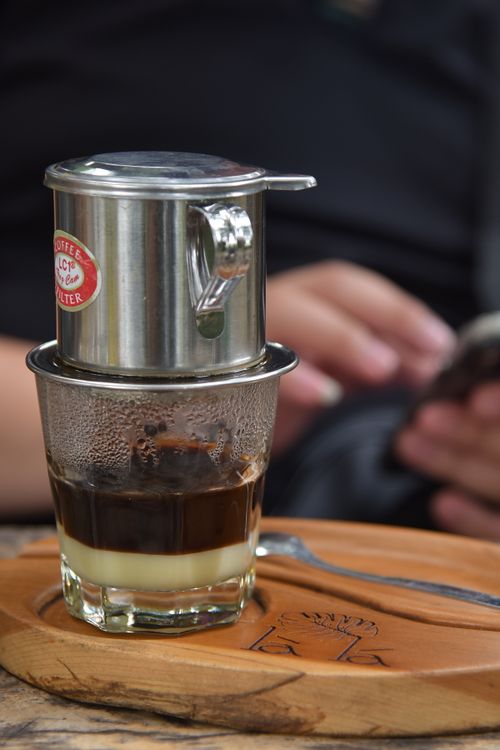
The phin (pronounced \”feen\”) is the heart of it all — a small metal filter that sits on top of your cup. You pack in the grounds, pour in hot water, and wait. It takes five minutes. That’s the point. So here are 7 Vietnamese coffee styles you need to try, from the iconic to the weird.
1. Cà Phê Sữa Đá — The Classic Iced Milk Coffee
This is the one. The definitive Vietnamese coffee. Dark Robusta grounds drip through a phin filter into a layer of sweetened condensed milk at the bottom of the glass. Once it’s done dripping, you stir it all together, pour it over ice, and drink.
The result is strong, sweet, and ridiculously smooth. The condensed milk isn’t just sweetener — it cuts through the bitterness of the Robusta beans (which have almost double the caffeine of Arabica, by the way).
Where to find it: Everywhere. Sidewalk stalls, Highlands Coffee, your hotel breakfast. A proper glass costs 15,000 – 25,000 VND (less than a dollar). Don’t pay more.
When to drink it: Morning, afternoon, after dinner. Vietnamese people drink it all day.
Order it: \”Cho toi mot ly ca phe sua da\” — give me one iced milk coffee.
2. Cà Phê Trứng (Egg Coffee) — Hanoi’s Signature
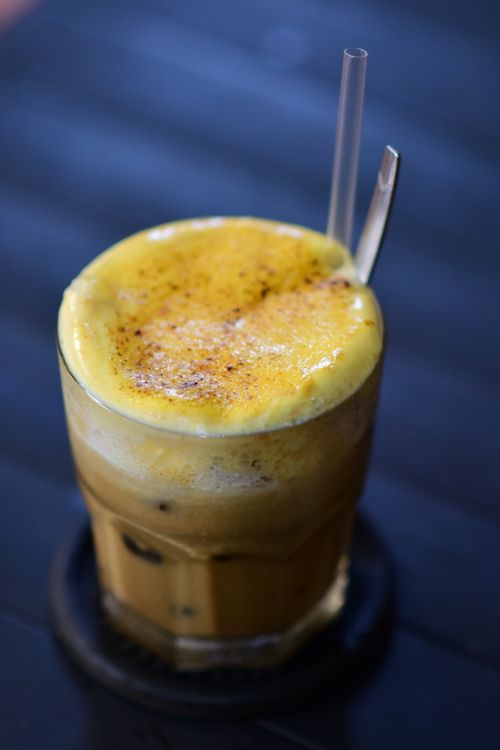
Invented in the 1940s when milk was scarce in Hanoi, the story goes that Mr. Giang — founder of Giang Cafe — whisked egg yolks with sugar and condensed milk to create a frothy topping, inspired by the cappuccinos he’d seen at the Metropole Hotel. The result? A drink that’s half coffee, half dessert, and entirely addictive.
A good egg coffee has a thick, golden cream on top — almost like custard — sitting on a strong black coffee base. You don’t stir it. You sip the cream and coffee together. It’s rich. It’s sweet. It’s the texture of melted ice cream in a coffee cup.
Where to find it: Giang Cafe (39 Nguyen Huu Huan, Hanoi) is the original. Cafe Dinh is its rival — same family, different owner, also excellent. Both are in the Old Quarter.
The honest take: It’s rich. Some people find one cup enough for a year. Others (like me) crave it the second they land in Hanoi. Worth trying at least once — and if you don’t love it, the coffee base underneath is still excellent on its own.
3. Cà Phê Muối (Salt Coffee) — The Hue Invention
Salt in coffee sounds wrong. I know. But trust me on this one — it’s the most underrated drink in Vietnam.
Originating in Hue, salt coffee starts with condensed milk at the bottom, strong coffee in the middle, and a creamy, salted foam on top. The salt doesn’t make it savoury — it enhances the sweetness of the condensed milk and rounds off the bitterness of the Robusta. It’s like salted caramel, but better because it didn’t come from a factory.
The first time I tried it was at a small cafe opposite the exit to Ho Chi Minh’s Mausoleum in Hanoi. I asked for egg coffee. The lady running the place said \”No — you have salt coffee.\” Best decision she made for me. I drank it every day for the next five weeks.
Where to find it: Hue is the spiritual home. But it’s spread across Vietnam now — Hanoi, Saigon, Da Nang all have cafes serving it. Look for places with \”ca phe muoi\” on the menu.
Order it: \”Cho toi mot ly ca phe muoi\” — one salt coffee, please.
If you’re planning a trip to Hue to try it at the source, check out MIA Hue Tours for the best local experiences — they’ll take you to the real spots, not the tourist ones.
4. Cà Phê Dừa (Coconut Coffee) — Modern Favorite
Coconut coffee is a newer addition to the Vietnamese coffee scene, but it’s earned its place fast. Blended with coconut milk or coconut cream, it’s creamy, naturally sweet, and tastes like a tropical vacation in a glass.
Unlike egg coffee (which can be too rich for some), coconut coffee is lighter. The coconut flavor is subtle — it doesn’t overpower the coffee. Some places blend it with ice for a frappe-like texture. Others serve it over ice with the coconut cream floating on top.
It’s become a staple at chains like Cong Caphe (which does a genuinely good version) and at independent cafes across Saigon and Hanoi.
Order it: \”Cho toi mot ly ca phe dua\” — coconut coffee, easy.
Best time: Afternoon, when the heat hits and you want something cold and sweet.
5. Bạc Xỉu — Saigon’s Gentler Coffee
Bac xiu is what happens when the Chinese community in Saigon’s Cholon (Chinatown) decided that traditional Vietnamese coffee was too strong. They added more milk and less coffee, creating a drink that’s milky, sweet, and dangerously easy to down in one sitting.
The name comes from the Cantonese \”bạc xỉu\” meaning \”white\” — referring to the pale color from all that milk. It’s what locals order when they want coffee flavor without the full caffeine wallop. Perfect for afternoons, or for people who find ca phe sua da too intense.
Where to find it: Any cafe in Saigon. Street stalls in Cholon make it best. It’s usually cheaper than a regular iced coffee (less coffee = less cost), so don’t let anyone charge you more.
Order it: \”Cho toi mot ly bac xiu\” — and watch the barista pour what’s basically a latte, Vietnamese-style.
6. Cà Phê Sữa Chua (Yogurt Coffee) — The Tangy Surprise
Yes, yogurt and coffee. Don’t question it — just try it.
Yogurt coffee is a Hanoi specialty (like egg coffee) but much less known. It’s exactly what it sounds like: a layer of thick Vietnamese yogurt at the bottom of the glass, topped with iced black coffee and crushed ice. You stir it together and drink. The tartness of the yogurt cuts through the bitterness of the coffee in a way that somehow works perfectly.
It’s refreshing, it’s tangy, and it has protein. A great breakfast drink — especially with a banh mi on the side.
Where to find it: Hanoi’s Old Quarter — look for cafes near Dong Xuan Market. It’s rare in Saigon.
Order it: \”Cho toi mot ly ca phe sua chua\” — one yogurt coffee.
7. Cà Phê Đen Đá — Pure, No Apologies
No milk. No sugar (unless you ask). Just dark Robusta coffee, brewed through a phin, poured over ice. This is for purists.
Ca phe den da is not for everyone. Robusta is naturally more bitter than Arabica, and without the condensed milk to balance it, you get a sharp, intense brew that hits you fast. But if you like your coffee black and unforgiving, this is the one.
Vietnamese people who drink it black usually add a bit of sugar — the sugar granules they use are finer than Western granulated sugar, so it dissolves instantly in the hot brew. A splash of hot water before the ice helps too.
Order it: \”Cho toi mot ly ca phe den da\” — and specify \”it\” (less sweet) or \”ngot\” (sweet) depending on your preference.
Perfect for: People who find ca phe sua da too sweet. Also great for checking if a cafe uses good beans — bad Robusta is undrinkable black.
Before You Go
- The phin takes 5 minutes. That’s not slow service — that’s the experience. Wait for it. Watch it drip.
- Robusta has double the caffeine of Arabica. Your second cup hits different. Pace yourself.
- Street coffee is cheaper and often better than cafes. A plastic stool, 15,000 VND, and the sound of motorbikes — that’s the real coffee experience.
- Learn the names: “Den” (black), “Sua” (milk), “Nong” (hot), “Da” (iced). Mix and match. “Ca phe sua nong” = hot milk coffee. “Ca phe den da” = iced black coffee.
- Bring cash. Street stalls don’t take cards. Small bills preferred.
The Short Version
Vietnamese coffee is its own universe. If you only try one drink, make it ca phe sua da (iced milk coffee) — it’s the gateway. But go beyond that. Have egg coffee in Hanoi, where it was born. Have salt coffee and understand why Hue is quietly winning the coffee war. And save room for the weird ones: yogurt coffee, coconut coffee, whatever you find.
And if you want to explore Saigon’s food and coffee scene with someone who knows where to go, join our Saigon food tour by scooter — we’ll show you where locals actually drink their coffee, not the tourist spots. For more food inspiration, check out our HCMC street food guide too.


Content summary
Other blogOther blog
Related blogs

What to Eat in Hue — 10 Dishes Locals Actually Eat
Hue is Vietnam’s food capital and criminally underrated. Here are 10 dishes locals actually eat — where to find them and what they cost.
Where to Stay in Hoi An — Best Areas & Hotels for Every Budget
Old Town or the beach? Here’s the honest breakdown of every Hoi An neighborhood — what each one is like, who it suits, and real hotels at real prices.
10 Best Things to Do in Ben Tre — Coconut Canals, Sunset Birds & Real Mekong Life
Only 85km from Saigon, Ben Tre is the Mekong at its most authentic. Here are 10 things to do — coconut canals, warm candy, sunset storks and food worth the drive.